Lord’s Day 5 · Part II: Deliverance
The Need for a Mediator
Taught by a pastor from the Reformed churches. The whole series on YouTube
Free video courseTake this Lord’s Day as a step in the course, with checkpoints along the way and a certificate at the end.Go to the courseAnswers are hidden. Say each one, then tap it to check.
According to God’s righteous judgment we deserve punishment both now and in eternity: how then can we escape this punishment and return to God’s favor?
Since then, by the righteous judgment of God, we deserve temporal and eternal punishment; is there no way by which we may escape that punishment, and be again received into favour?
God will have his justice satisfied: and therefore we must make this full satisfaction, either by ourselves, or by another.
Since, then, by the righteous judgment of God we deserve temporal and eternal punishment, what is required that we may escape this punishment and be again received into favor?
God wills that his justice be satisfied; therefore must we make full satisfaction to the same, either by ourselves or by another.
Dieweil wir denn nach dem gerechten Urtheil Gottes zeitliche und ewige Strafe verdienet haben: wie möchten wir dieser Strafe entgehen, und wiederum zu Gnaden kommen?
Gott will, daß seiner Gerechtigkeit genug geschehe; deßwegen müssen wir derselben entweder durch uns selbst, oder durch einen Andern vollkommene Bezahlung thun.
- 1Ex. 23:7; Rom. 2:1-11
- 2Isa. 53:11; Rom. 8:3-4
Can we make this payment ourselves?
Certainly not. Actually, we increase our debt every day.1
Can we ourselves then make this satisfaction?
By no means; but on the contrary we daily increase our debt.
Can we ourselves make this satisfaction?
By no means; on the contrary, we daily increase our guilt.
Können wir aber durch uns selbst Bezahlung thun?
Mit nichten: sondern wir machen auch die Schuld noch täglich größer.
- 1Matt. 6:12; Rom. 2:4-5
Can another creature—any at all—pay this debt for us?
Can there be found anywhere, one who is a mere creature, able to satisfy for us?
None; for first, God will not punish any other creature for the sin which man hath committed; and further, no mere creature can sustain the burden of God's eternal wrath against sin, so as to deliver others from it.
Can any mere creature make satisfaction for us?
None; for, first, God will not punish, in any other creature, that of which man has made himself guilty; and, further, no mere creature can sustain the burden of God's eternal wrath against sin, and redeem others therefrom.
Kann aber irgend eine bloße Creatur für uns bezahlen?
Nein: denn erstlich will Gott an keiner andern Creatur strafen, was der Mensch verschuldet hat. Zum andern, so kann auch keine bloße Creatur die Last des ewigen Zornes Gottes wider die Sünde ertragen, und andere davon erlösen.
- 1Ezek. 18:4.20; Heb. 2:14-18
- 2Ps. 49:7-9; 130:3
What kind of mediator and deliverer should we look for then?
What sort of a mediator and deliverer then must we seek for?
For one who is very man, and perfectly righteous; and yet more powerful than all creatures; that is, one who is also very God.
What manner of mediator and redeemer, then, must we seek?
One who is a true and sinless man, and yet more powerful than all creatures; that is, one who is at the same time true God.
Was müssen wir denn für einen Mittler und Erlöser suchen?
Einen solchen, der ein wahrer und gerechter Mensch, und doch stärker denn alle Creaturen, das ist, zugleich wahrer Gott sei.
- 1Rom. 1:3; 1 Cor. 15:21; Heb. 2:17
- 2Isa. 53:9; 2 Cor. 5:21; Heb. 7:26
- 3Isa. 7:14; 9:6; Jer. 23:6; John 1:1
TranscriptRead the film: Lord’s Day 5Tap a time to play the film from there · transcribed from the film
According to God’s righteous judgment, we deserve punishment, both now and in eternity. How then can we escape this punishment and return to God’s favor? God requires that his justice be satisfied. Therefore, the claims of this justice must be paid in full, either by ourselves or by another. Can we make this payment ourselves? Certainly not. Actually, we increase our debt every day. Can another creature, any at all, pay this debt for us? No. To begin with, God will not punish any other creature for what a human is guilty of. Furthermore, no mere creature can bear the weight of God’s eternal wrath against sin and deliver others from it. What kind of mediator and deliverer should we look for, then? One who is a true and righteous man, yet more powerful than all creatures. That is, one who is also true God.
We come now into the second main part of the catechism, dealing with deliverance, the blessing that we come to know, our deliverance, our salvation in the Lord Jesus Christ. Lord’s Day 5 follows right upon the heels of Lord’s Day 4, which left us in the lurch, you might say, it left us with the reality of hell. The seriousness of judgment, that sins committed against the supreme majesty of God be punished with the supreme penalty, eternal punishment of body and soul.
And over against all of the so-called objections in Lord’s Day 4, all of the ways in which we would have protested and sought to protect ourselves, Lord’s Day 5 now begins in the question that’s asked with an acknowledgement, a confession.
According to God’s righteous judgment, we deserve punishment. We deserve punishment both now and in eternity. So we come to the place where there is no more desire to get out from under this reality. It has to be confessed, needs to be acknowledged, and we need to begin to ask, what are we going to do about this? How are we going to deal with this? And so question 12 goes on to ask, how then can we escape this punishment and return to God’s favor? I think it’s very important that we appreciate that those two questions, it’s a two-part question, how then can we escape this punishment and return to God’s favor, have to be included together.
We might be satisfied with the idea, I just want to escape, I just want to escape this punishment that I know I deserve, that I know I’m worthy of, but that’s not sufficient. And there are many ways in which we may find ourselves seeking to escape. There are many diversions that people can pursue in life and we can all do this, right? If we have the idea, I’ll just escape any sort of needing to think about the reality of God, the reality of his perfect justice. I can escape by devoting myself to entertainment. Maybe I can escape in terms of devoting myself to substances that take my mind off things.
I can escape by busying myself with work, with pleasure, all kinds of things as a means of escape. But here we are running from God, and at the end of the day, there is no escape. Because the Catechism is reminding us and assuring us from the Bible, God requires that his justice be satisfied, and therefore the claims of his justice must be paid in full, either by ourselves or by another. So any of our own efforts at escape, any of our own diversions, will necessarily fall short. God’s justice must be satisfied and will be satisfied. So any sense in which we try to run away from these realities or run away from God will not be successful and not be helpful.
In fact, it’s exactly the opposite. Instead of running away from God, we need to come to the place where we are running to God. So it is escaping this punishment that we deserve and returning to God’s favor. So running to God. Now the question is, how do we do that? That’s the question that’s being asked for us here. And it’s a very fundamental question that we need to have an answer for. And the Catechism is taking its time, answering those questions for us to make sure that we’re not being frivolous or superficial, to make sure that we’re not missing the mediator, to make sure that we’re not missing the comfort that is found in Jesus.
And again, with the questions that are asked, the next question, question and answer 13, can we make this payment ourselves?
There’s kind of the acknowledgement there that there is a tendency among us to think, I can fix this. I can take care of this. I know there’s this talk about the judgment of God, and it is serious. We’re left with that reality, but I’ll take care of it. I’ll fix it. And so there is the sense that by our own devotion, we can make it better. And many people have the idea that if we pile up for ourselves accomplishments that God ought to be pleased with, and they outnumber our misdeeds, then we can come to God with a credit to our account.
But the reality of life and the teaching of the Bible, as is summarized for us here, when we ask this question, can we make this payment ourselves? The answer is certainly not. Actually, we increase our debt every day. So we’re not building up for ourselves a treasury of merits, of our accomplishments. In fact, the Bible tells us that even our best works are imperfect and stained with sin. And so every effort to try to say, here, God, you should be impressed with this, is imperfect and stained with sin. So we’re actually not piling up credits for ourselves. We’re increasing our debt. We’re treasuring up wrath for the day of wrath, as Romans chapter 2 teaches us.
So our own devotion is not going to help us. The catechism was helping us, I think, a little bit already by saying, the claims of God’s justice must be satisfied, paid in full, either by ourselves or by another. So we’ve already had the notion that we can do it ourselves taken away. If we’re honest, we know that that’s true. What about another? We continue to look around in desperation, and the catechism asks the question, can any other creature, can another creature, any at all, pay this debt for us? And so we’re looking for another way out. Is there any other way? And the Bible also makes plain, no, the catechism summarizes that teaching, no, to begin with, God will not punish any other creature for what a human is guilty of.
The soul that sins shall die. Ezekiel 18, verse 4. God will not punish any other creature. An angel cannot save us.
An animal cannot save us. The Bible makes very plain in the book of Hebrews, chapter 10, there is no salvation in the blood of goats and bulls. There is only salvation in the blood of Jesus Christ. We may be inclined to look in many other places, but the teaching of the scriptures summarized for us here, God will not punish any other creature for what a human is guilty of. Furthermore, no mere creature can bear the weight of God’s eternal wrath against sin and deliver others from it. If we were to look to anybody else, any other creature, to atone for our sin, that person, that creature, would be obliterated necessarily by the righteous wrath of God.
There would be nothing they could offer us, nothing they could share with us, nothing that could save us. So the teaching here that we must look to another is driving us to the realization we cannot do it. It can’t be done in our own strength.
So finally, the final question in the Lord’s Day, you might almost say, seems to be asked with a sense of desperation.
What kind of mediator and deliverer should we look for then? There’s the realization we cannot do it. There’s the realization we cannot come up with the answer. We cannot put together the way of salvation. We cannot save ourselves. We cannot get around the reality of God’s judgment. We cannot escape this punishment. We in and of ourselves cannot return to God’s favor. Now, the answer leaves us with the credentials of our mediator, his qualifications. And we’re going to have to wait until the next Lord’s Day to be introduced to him by name. Again, the catechism is going slowly to make sure that we’re not hasty, that we’re not jumping to conclusions, that we’re actually appreciating our own inability and our own need for the mediator.
The one, as we’re told here, who is a true and righteous man, yet more powerful than all creatures, that is one who is also true God. Now, none of us can say these particular things about ourselves, except for that we’re true humans. But we’re not righteous in and of ourselves. We don’t meet those qualifications.
And we’re not true God. We need a mediator who can meet those expectations, fulfill those credentials for us. And so what we see, what we’re left with at the end of this particular Lord’s Day, is the realization we can’t do it.
We cannot save ourselves. We cannot come up with a way to make ourselves acceptable to God. God’s got to do it. God’s got to come to us. And what we’re being encouraged about here in this teaching is, that’s exactly what he’s done in the Lord Jesus Christ. How can we escape this punishment? How can we return to God’s favor? It’s through the mediator, through the one he has sent. We need to satisfy God for his justice. We need to satisfy God and his righteous demands. Love me with all of your heart and soul, with all of your mind and strength, and love your neighbor as yourself.
But we can’t, and we don’t. Someone has to do it for us, and Jesus did.
 Plate I
The Ledger That Must Balance
Think of an accountant opening a ledger and finding numbers wildly out of line. Some debts can be overlooked as rounding errors, but when the deficit is catastrophic, the books demand reconciliation. God’s justice isn’t petty bookkeeping, it’s the moral structure of the universe. For the accounts of humanity to be settled, the debt must actually be paid, not merely ignored. The catechism teaches that forgiveness does not bypass justice; it fulfills it.
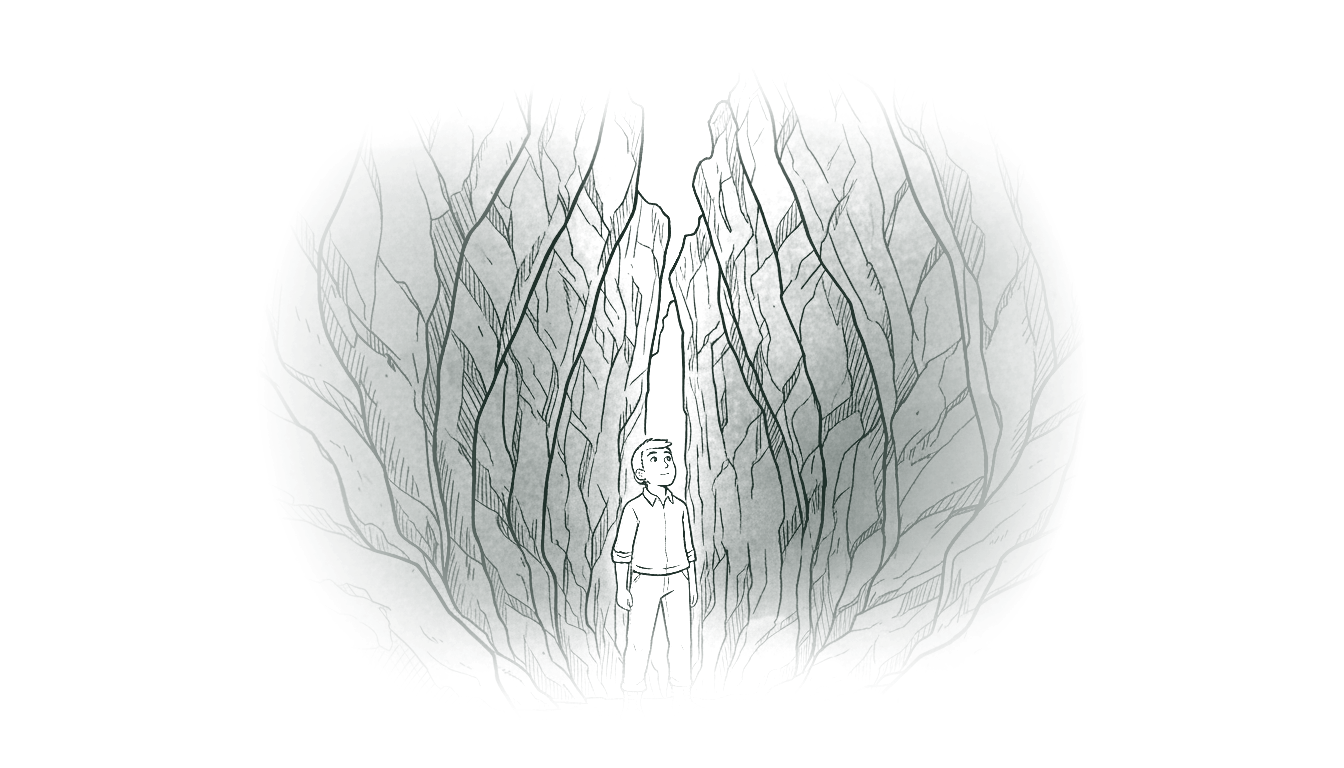 Plate II
Digging a Deeper Hole
Imagine falling into a deep pit and trying to climb out by digging footholds into the wall. Every attempt you make only crumbles the soil further, deepening the hole and making escape more impossible. Our attempts at self-salvation work the same way: what we intend as progress only exposes how incapable we are of fixing ourselves. The catechism’s honesty stings because it strips us of self-trust. We don’t slowly repay our moral debt, we compound it.
 CommentaryZacharias Ursinus on Lord’s Day 5From the catechism’s chief author · about 19 minutes
Question 12
According to God’s righteous judgment we deserve punishment both now and in eternity: how then can we escape this punishment and return to God’s favor?
Having shown, in the first part of the Catechism, that all men are in a state of eternal condemnation, on account of not having rendered the obedience which the law of God requires, we are next led to inquire whether there is, or may be, any way of escape or deliverance from this state of misery and death? To this question the catechism answers, that deliverance may be granted, if satisfaction be made to the law and justice of God, by a punishment sufficient for the sin that has been committed. The law binds all, either to obedience, or if this is not rendered, to punishment; and the performance or payment of either is perfect righteousness, which God approves of in whomsoever it is found.
There are two ways of making satisfaction by punishment. The one is by ourselves. This is the one which the law teaches and the justice of God requires. "Cursed is every one that continueth not in all things which are written in the law to do them." (Gal. 3:10.) This is legal.
The other way of making satisfaction is by another. This is the method which the gospel reveals, and the mercy of God allows. "What the law could not do, in that it was weak through the flesh, God, sending his own Son, &c." "God so loved the world, that he gave his only begotten Son, &c." (Rom. 8:3. John 3:16.) This is evangelical. It is not, indeed, taught in the law; but it is no where condemned, or excluded. Neither is it repugnant to the justice of God; for if only satisfaction be made on the par of man by a sufficient punishment for his disobedience, the law is satisfied, and the justice of God permits the party offending to be set at liberty, and received into favor. This is the sum and substance.
Furthermore, there are two things taught in this question; the possibility of this deliverance, and how it is effected. That these things may be better understood, we shall now consider:
I. What the deliverance of man is:
II. Whether such a deliverance be possible:
III. Whether it be necessary and certain:
IV. Whether a perfect deliverance may be expected:
V. How it is accomplished.
I. WHAT THE DELIVERANCE OF MAN IS
The word deliverance is relative; for every deliverance is from something to something, as from captivity to liberty. As now all men, by nature, are the slaves of sin, satan, and death, we cannot better and more correctly understand what the deliverance of man is, than by a consideration of what his misery consists in. The misery of man consists, first, in the loss of righteousness, and in inbred corruption, or sin; and secondly, in the punishment of sin. His deliverance, therefore, from this misery, requires, first, the pardon and abolishing of sin, and a restoration of the righteousness lost: and secondly, a release from all punishment and misery. As therefore, the misery of man consists of two parts—sin and death—so his deliverance consists of two parts—a deliverance from sin and death. Deliverance from sin includes the pardon of sin, that it may not be imputed unto us, and an abolishing of sin by the renewing of our nature, that it may not reign in us. Deliverance from death, is a deliverance from despair, and a sense of the wrath of God—from the calamities and miseries of this life; and also from death, both temporal and spiritual.
From these things it is easy to perceive what we are to understand by the deliverance of man. It consists in a perfect deliverance from all the miseries of sin and death, which the fall has entailed upon man, and a full restoration of righteousness, holiness, life, and eternal felicity, through Christ; which is begun in all the faithful in this life, and will be fully perfected in the life to come.
II. WHETHER SUCH A DELIVERANCE BE POSSIBLE
That this deliverance of man from the ruins of the fall was possible, may be inferred from a consideration:
1. Of the immense goodness and mercy of God, which would not suffer the whole human race to perish forever.
2. The infinite wisdom of God would naturally lead us to expect that he would be able to devise a way by which he might exhibit his mercy towards the human race, and yet not violate his justice.
3. A consideration of the power of God might lead us to the conclusion that he who could create man out of nothing after his own image, could also raise him up from the ruins of the fall, and deliver him from sin and death. To deny the possibility of the deliverance of man is, therefore, to deny the goodness, wisdom, and power of God. But in God there is neither wisdom, nor goodness, nor power wanting; for "the Lord bringeth down to the grave and bringeth up." "Unto God, the Lord, belong the issues from death." "The Lord's hand is not shortened, that it cannot save." (1 Sam. 2:6. Ps. 68:20. Is. 59:1.)
But we must enquire, particularly, Whence do we know this deliverance to be possible? Whether human reason, without the word of God, can arrive at this knowledge? And whether Adam, after his fall, could know or hope for it?
That our deliverance was possible, we now know from the event itself, and from the gospel, or from that revelation which God has been pleased to make. Human reason, however, if left to itself, could know nothing of this deliverance, or of the manner in which it could be effected, although it might probably have conjectured that it was not impossible, (which, by the way, is very doubtful,) in as much as it is not presumable that so glorious a creature as man would be created for eternal misery; or that God would give a law that could never be fulfilled. These two arguments are in themselves forcible, but human reason, on account of its corruption, does not subscribe to them. As, therefore, those who are without the church and ignorant of the gospel, can have no knowledge or hope of deliverance; so Adam, after the fall, without a special promise and revelation, could neither know nor hope for it, by the mere exercise of his reason. When sin was once committed, the mind of man could think of nothing but the severe justice of God, which does not permit sin to pass with impunity, and the unchangeable truth of God, which had declared, "In the day thou eatest thereof, thou shalt surely die." (Gen. 3:17.) Adam knew full well that it was necessary to make satisfaction to this justice and truth of God, by the everlasting destruction of the sin ner; and hence he could not hope for any deliverance in his case. He might, indeed, probably have supposed that deliverance could be effected if satisfaction could be made in any way, to the justice and truth of God; but he could neither hope for it nor conceive how, or by whom it could be accomplished; yea, the angels themselves could never have devised this method of deliverance, had not God, out of his infinite wisdom and goodness, conceived it and made it known through the gospel.
But some object to what is here said, as follows: If deliverance seemed impossible to Adam, on account of the justice and truth of God, then it must now, also, seem to be impossible; for a violation of the justice and truth of God, cannot take place now any more than formerly. But the escape of the sinner from punishment would be a violation of these attributes of God. To this we reply, that if the sinner would escape punishment without a sufficient satisfaction being made for sin, it would, indeed, be a violation of the justice and truth of God. Had Adam seen a satisfactory solution of this problem, he would have had reason to hope for deliverance, especially if he had considered, at the same time, the nature of God, his infinite goodness, wisdom, and power, and the end for which he created man; and that it would not be consistent with the character of God, who is most wise, good, and powerful, to create a being of such noble powers as man, to endure everlasting misery; or that he would give such a law to man, as could never be perfectly obeyed. Yet he could not entertain any certain hope, for, as we have already remarked, before the gospel was published, neither he, nor any other creature, was able to see, or contrive a way of escape from punishment, that would be in harmony with the justice of God; nor could any way of escape ever have been contrived, had not God revealed it through his Son.
This, now, is the substance of what has been said: Man, being fallen, could hope for no deliverance from sin and death, before he heard the joyful promise that the seed of the woman should bruise the head of the serpent; but yet he ought not, neither could he simply despair as though it were wholly impossible. For although he could not conceive any necessary reason from which he might conclude upon his future deliverance, nor understand the way in which satisfaction could be made, yet it does not follow, that if a creature could not discover this, therefore God could not discover it. He ought, therefore, to have looked away from himself to the wisdom, goodness, and power of God, and not have despaired, although every thing seemed to drive him to desperation. Yet if the sound of the gospel had not reached his ear, nothing could have sufficiently comforted him under the temptations to which he was exposed. But after the promise was once made known, and he was brought to understand the method of redemption through Christ, then he could not only hope for deliverance with certainty, but could also resolve all doubts and objections which might arise, among which we may mention the following:
Obj. 1. The justice of God does not permit those who are deserving of eternal condemnation to go unpunished. We have all deserved eternal condemnation. Therefore, our deliverance is impossible, on account of the justice of God. Ans. Adam saw how the first proposition of this syllogism could be answered, viz: that the justice of God does not absolve and acquit those who are deserving of everlasting condemnation, unless satisfaction be made by a punishment corresponding with the offence.
Obj. 2. The justice and truth of God are both violated when that is not done which the former requires and the latter threatens. But if everlasting punishment and death be not inflicted upon man, that is not executed which the justice of God requires, and his truth threatens. Therefore, both are violated if man be not punished, which is impossible. Ans. Here again, Adam saw that the minor proposition was true only in case no punishment at all were inflicted, neither upon the sinner himself nor upon some one else who might offer himself as a substitute in the sinner's room and stead. But the promise which God had been pleased to reveal to him, made him acquainted with the fact that Christ, the seed of the woman, would, as man's substitute, bruise the serpent's head.
Obj. 3. That which the unchangeable truth and justice of God demand, is necessary and unchangeable. But the unchangeable truth and justice of God demand that the sinner be cast into everlasting punishment. Therefore the rejection of the sinner is necessary and unchangeable. Ans. He also saw an answer to the principal proposition of this objection, viz: that that is unchangeable which the justice of God demands absolutely, and not that which it requires conditionally; demanding either the everlasting punishment of the transgressor, or satisfaction through Christ.
Obj. 4. That is impossible which we have not the power of escaping. We have not the power of escaping sin and death. Therefore it is impossible for us to escape these evils. Ans. But here again Adam saw that an escape from these evils was impossible only in case God neither knew nor would reveal the way of deliverance, which was unknown to human reason, and to all created beings, and which they never could have discovered.
These and similar objections Adam was enabled, through the promise of the seed of the woman bruising the serpent's head, to repel and overcome. We, however, who live at the present day, can see, and understand much more clearly, the solution of these difficulties, than Adam could, inasmuch as we know certainly, from the gospel and the event itself, as well as from our own consciousness, that the deliverance of man was not only possible, and would take place at some future time, as Adam himself saw, but that it is also already accomplished by Christ. Hence the deliverance of man is, and always was, possible with God.
III. WHETHER DELIVERANCE BE NECESSARY AND CERTAIN
Although God was not under the least obligation to deliver man from the misery of sin, but was free to leave all men in death, and save none; for "Who hath first given to him, and it shall be recompensed unto him again," (Rom. 11:35); yet it may correctly be said, that man's deliverance was and is necessary,—understanding by this term not an absolute, but a conditional necessity, as it is called. This is proven:
1. Because God has most freely and unchangeably decreed and provided it; and it is impossible that he should lie, or be deceived. "As I live, I have no pleasure in the death of the wicked, but that," &c. (Ez. 18:23.)
2. Because God desires to be praised and glorified forever by man. "He hath made us to the praise of the glory of his grace." "Wherefore hast thou made all men in vain." (Eph. 1:6. Ps. 89:47.)
3. Because God did not in vain send his Son into the world, neither did Christ die in vain. "I came down from heaven, not to do mine own will, but the will of him that sent me. And this is the Father's will, which hath sent me, that of all which he hath given me, I should lose nothing," &c. "I came to call sinners to repentance." "Who was delivered for our offences, and was raised again for our justification." "If righteousness come by the law, then Christ is dead in vain." (John 6:38, 39. Matt. 9:13. Rom. 4:25. Gal. 2:21.)
4. Because God is more inclined to mercy than to wrath. But in the punishment of the wicked his wrath is manifested; much more, therefore, will he manifest his mercy in the salvation of the righteous.
IV. WHETHER A PERFECT DELIVERANCE MAY BE EXPECTED
This deliverance of man is perfect in this life, as it respects the commencement of it; but in the life to come, it will be perfect also as it respects the consummation of it. Now, it is perfect in all its parts, being a deliverance from the evil both of guilt and of punishment; then, it will be perfect also in the degrees of it, when all tears shall be wiped away from our eyes, when the perfect image of God will be restored in us, and God shall be all, and in all. This is proven:
1. Because God does not deliver us only in part, but saves and loves perfectly all those whom he saves. "The blood of Jesus Christ cleanseth us from all sin." (1 John 1:7.)
2. Because God will punish the wicked most severely, that they may by these punishments fully satisfy his justice. He will, therefore, also perfectly deliver the godly, since he is more inclined to mercy than wrath. Neither is the benefit of Christ more imperfect, or of less force than th sin of Adam. This would be the case, if he did not deliver us perfectly because we have lost all righteousness and salvation in Adam. A perfect deliverance is, therefore, to be expected, but by degrees, as it has been shown. In this life it is perfect; in the resurrection it will be more perfect; and in glorification it will be most perfect.
V. HOW THIS DELIVERANCE IS ACCOMPLISHED
The deliverance of which we have now spoken is accomplished: 1. By a full and sufficient satisfaction for sin. There is such a satisfaction, when the punishment which is inflicted on account of sin is equivalent to that which is eternal. 2. By abolishing sin, and renewing our nature, which is done by restoring in us the righteousness and image of God which we have lost, or by the perfect regeneration of our nature. Both of these are necessary to our deliverance.
Satisfaction is necessary, because the mercy of God, as has been shown, does not violate his justice, which demands satisfaction. The law binds either to obedience or punishment. But satisfaction cannot be made through obedience, because our past obedience is already impaired, and that which follows cannot make satisfaction for past offences. We are bound to render exact obedience every moment to the law, as a present debt. Hence, obedience being once impaired, there is no other way of making satisfaction except by punishment, according to the threatening: "In the day that thou eatest thereof, thou shalt surely die." (Gen. 2:17.) If a sufficient punishment be endured to satisfy the law, God is reconciled, and deliverance becomes possible.
So, in like manner, the abolishing of sin, and the renewing of our nature are necessary: because it is only upon the condition that we cease to offend God by our sins, and are thankful to him for our reconciliation, that he is willing to accept of this satisfaction. To be willing that God should receive us into his favor, and yet not be willing to abandon sin, is to mock God. But it is not possible for us to leave off and forsake sin, unless our nature be renewed. It is in this way, therefore, that the deliverance of man is made possible.
Question 13
Question 13: Can we make this payment ourselves?
Having given an explanation of the manner in which our deliverance is accomplished, we must now inquire by whom this satisfaction, and abolishing of sin can be effected: whether by ourselves, or by some one else? And if by some one else, whether it be by a mere creature? And if not by a mere creature, by whom, therefore, and by what kind of a mediator? The first of these questions is answered in this 13th Question of the Catechism. The other two are answered in the 14th and 15th Questions of the Catechism.
We cannot make this satisfaction by and of ourselves, neither by obedience nor by punishment.
We cannot make it by obedience, because whatever good we perform we owe to God by present obligation. Hence it is impossible for us to satisfy for our past offences by any present obedience which we may render to the law of God, for we cannot deserve any thing at the hands of God for the present, much less for the time to come; neither can a double merit, that is to say, a merit for the present and the future, proceed from one satisfaction.
A more common and popular reason is assigned in the Catechism: because we daily increase our debt. We sin continually, and in sinning we increase our guilt and the displeasure of God towards us. Now he who never ceases to offend can never appease the party offended, just as a debtor who continually adds new accounts to former claims can never release himself from debt.
Neither can we make satisfaction to God for our sins by punishment, because our guilt being infinite, deserves an infinite punishment—one that is eternal, or that is equivalent to everlasting punishment. Sin being an offence against the highest good, deserves eternal condemnation, or at least such a temporal punishment as is equivalent to that which is eternal. But we cannot make satisfaction by a punishment that is eternal, because then we should never be freed from it. We would always be making satisfaction to the justice of God, and yet it would never be fully satisfied. Our satisfaction would never be perfect—it would never be a complete victory over sin and death, but would continue imperfect to all eternity, as the satisfaction of devils and wicked spirits. Nor can we make satisfaction by enduring such a temporal punishment as will be equivalent to that which is eternal, which is necessary in order that death may be overcome. Such a punishment as this cannot be endured by any mere creature, on account of many imperfections, as we shall presently show.
As we cannot, therefore, make satisfaction by ourselves, there is a necessity that this satisfaction should be made by another, if we would obtain deliverance from our misery.
From this we may readily return an answer to the following objection, which is sometimes made: We can never satisfy the law, neither by punishment nor obedience. Therefore the method of deliverance through satisfaction is of no account. Ans. It is not of small account; because although we are not able to make satisfaction through obedience, we are, nevertheless, able to make it through the endurance of a sufficient punishment, not in ourselves, but in Christ, who has satisfied the law both by obedience and punishment. Against this the following objections have been urged:
Obj. 1. The law requires our own obedience or punishment; because it is written: "He that doeth these things shall live by them." "Cursed be he that confirmeth not all the words," &c. Ans. The law does indeed require our obedience or punishment, but not exclusively, for it never excludes or condemns the satisfaction of another in our behalf, although it does not teach it, and is ignorant of it. But the Gospel reveals and shows this unto us in Christ.
Obj. 2. It is unjust to punish another in the place of the guilty. Therefore Christ could not be punished in our room and stead. Ans. It is not inconsistent with the justice of God that another should be punished in the place of those who are guilty, if these conditions are present. 1. If he who is punished be innocent. 2. If he be of the same nature with those for whom he makes satisfaction. 3. If he, of his own accord, offer himself as a satisfaction. 4. If he himself be able to endure and come forth from this punishment. This is the reason why men cannot punish one person in the place of another, because they cannot bring it to pass that the one that suffers should not perish under the punishment. 5. If he look to, and obtain the end which Christ had in view, viz: the glory of God and the salvation of man.
Question 14
Can another creature—any at all—pay this debt for us?
The exclusive particle mere is added in this question, that the negative answer may be true; for it was necessary that a creature should make satisfaction for the creature's sin, but not such an one as was merely or only a creature, because such an one could not make the satisfaction which was required, as will appear in the remarks which we shall now make.
We must, therefore, since satisfaction must be made through another, enquire, whether this other person may be any creature besides man; and whether he may be a mere creature. We deny both propositions. Our reason for denying the first is, because God will not punish the sin which man has committed in any other creature. This is in accordance with the order of his justice, which does not permit one to sin and another to bear the punishment. "The soul that sinneth, it shall die." (Ez. 18:20.) This reason proves that no creature, except man could satisfy for man: yea, God could not be satisfied for the sin of man by the eternal destruction of heaven and earth, and of the angels themselves, and all other creatures. Our reasons for denying the second proposition are these: 1. Because no creature possesses such power as to be able to sustain a finite punishment, equivalent to that which is infinite, for the purpose of making satisfaction for the infinite guilt of man. A mere creature would be consumed and reduced to nothing, before satisfaction could be made to God in this way: "For God is a consuming fire." "If thou shouldst mark iniquities, O Lord, who shall stand?" "For what the law could not do, in that it was weak through the flesh, God sending his own Son in the likeness of sinful flesh." &c. (Deut. 4:24. Ps. 130:3. Rom. 8:3.) This reason proves that no creature in the whole universe was able to make satisfaction to God for man's sin, by punishment, so as to come forth from the same, which escape was necessary in order to our deliverance. There could, therefore, in this way, on account of the weakness of the creature, be no just proportion between sin and its punishment. 2. Because the punishment of a mere creature could not be a price of sufficient dignity and value for our redemption. 3. Because a mere creature could not have renewed and sanctified our nature, nor could such an one have brought it to pass that we should no longer sin, all of which it was necessary for our deliverer to accomplish.
Question 15
What kind of mediator and deliverer should we look for then?
Since, then, we are not able of ourselves to make satisfaction to God for our sins, but must have some other satisfier or mediator in our place, we must enquire further, What sort of a deliverer must he be? To this we may reply, that he must of necessity be merely a creature, or merely God, or both. A mere creature, however, he cannot be, for the reasons already assigned. Merely God he could not be, because man, and not God, had sinned; and also because it behooved the mediator to suffer and die for the sins of man. But God, in himself, can neither suffer nor die. It follows, therefore, that such a mediator is required who is both God and man. The reasons for this will be assigned in the questions immediately following.
Sing this Lord’s Day
A confessional hymn by Paul Wagenaar that puts Lord’s Day 5 to verse, for children and adults alike.